
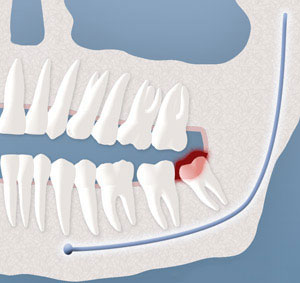
Third molars are commonly referred to as wisdom teeth. They are usually the last teeth to develop and are located in the back of your mouth, behind your second molars. Their development is usually completed between the middle teenage years and early twenties, a time traditionally associated with the onset of maturity and the attainment of wisdom.
Call 410-268-7790 to schedule your wisdom teeth consultation.
To read more about wisdom teeth view our informative pages below.
With an oral examination and x-rays of the mouth, Dr. Walzer, Dr. Sullivan, Dr. Hlousek, Dr. Jones, Dr. Chambers and Dr. Kufta can evaluate the position of the wisdom teeth and predict if there are present or future potential problems. Studies have shown that early evaluation and treatment result in a superior outcome for the patient. Patients are generally first evaluated in the mid-teenage years by their dentist, orthodontist, or by an oral and maxillofacial surgeon.
All outpatient surgery is performed under appropriate anesthesia to maximize patient comfort. Our doctors are trained, licensed, and highly experienced in providing various types of anesthesia for patients.
If you do not have enough room in your mouth for your third molars to fully erupt, a number of problems can happen. Impacted wisdom teeth should be removed before their root structure is fully developed. In some patients it is as early as 12 or 13, and in others it may not be until the early twenties. Problems tend to occur with increasing frequency after the age of 30.
Some of the possible problems related to not removing your wisdom teeth include:

The most frequent clinical problem we see is pericoronitis (a localized gum infection). Without enough room for total eruption, the gum tissue around the wisdom tooth can become irritated and infected, resulting in recurrent pain, swelling, and problems with chewing and/or swallowing.
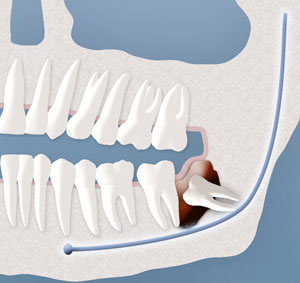
Non-infectious diseases may also arise in association with an impacted wisdom tooth. Cysts are fluid-filled “balloons” inside the jawbone that develop as a result of impacted teeth and slowly expand, destroying adjacent jawbone and occasionally teeth. They can be very difficult to treat if your wisdom teeth are not removed in your teenage years. Although rare, tumors can be associated with the delayed removal of wisdom teeth.
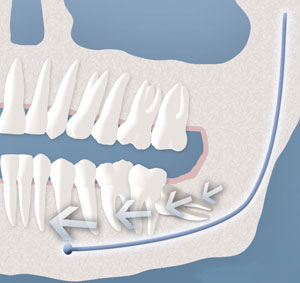
Impacted wisdom teeth may contribute to crowding of your teeth. This is most noticeable with the front teeth, primarily the lower front teeth, and is most commonly seen after a patient has had braces. There are a number of factors that cause teeth to crowd after braces or in early adulthood. Retained, impacted wisdom teeth may be a contributing factor.
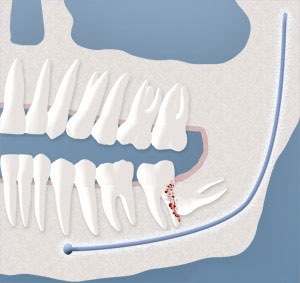
If there is inadequate room to clean around the wisdom tooth, the tooth directly in front, the second molar, can be adversely affected resulting in gum disease, bone loss around the tooth, and/or decay.
As wisdom teeth develop, the roots become longer and the jaw bone more dense. When it is necessary to remove impacted wisdom teeth in your thirties, forties or beyond, the post-operative course can be prolonged and there is a higher complication rate. Treating these complications is often more difficult and less predictable than with a younger patient. Healing may be slower and the chance of infection can be increased. If your impacted wisdom teeth are not removed in your teenage years or early in your twenties and they are completely impacted in bone, it may be advisable to wait until a localized problem (such as cyst formation or localized gum disease and bone loss) develops. In general, you will heal faster, more predictably and have fewer complications if treated in your teens or early twenties.
If your surgery requires stitches, these are usually the type that dissolve in 3-to-5 days and do not require removal. You may also notice a sensation of your gums feeling swollen and pulling away from your teeth. This is all part of the normal recovery, and will subside in several days.
Once the local anesthesia wears off, you may require prescription pain medication. Please try non-narcotic anti-inflammatory medications such as ibuprofen (Advil®) first, to see if that adequately treats your pain. If not, begin your other prescription pain medication. The local anesthesia may last until the following day, and should not be confused with an injury to your nerve. We recommend starting your post-operative diet with clear liquids such as jello and broths, gradually increasing in substance as your body permits.
We do not recommend using dairy products such as yogurt, ice cream or milkshakes on the day of surgery, as nausea and vomiting may develop in conjunction with the anesthetic and pain medication. If you are given antibiotics and you take birth control pills, please be aware that the birth control pills might become ineffective and take appropriate precautions.
Be sure to have an adult with you at the time of removal. Make plans to have a parent or responsible adult stay with you for the rest of the day, following wisdom tooth removal.
The fee for your treatment is determined by a number of factors. These may include the difficulty involved in removing your teeth and which type of anesthesia is best for you. During your consultation appointment, the surgeon will need to review your x-rays, complete an examination and determine the best option for anesthesia, before an accurate estimate can be provided. Every insurance company has a different policy regarding the extent of coverage for a given surgical procedure. The oral surgeon’s office staff will help you obtain maximum insurance coverage for your treatment.
At the time of your consultation, your specific situation will be discussed in greater detail. We encourage you to ask any questions you may have. If new questions arise after your consultation, please call our office at Annapolis Office Phone Number410-268-7790 to speak to one of our patient care coordinators.
Please do not eat or drink anything prior to your surgery. Having anything in your stomach can increase the risk for serious anesthetic complications.
Our practice offers comprehensive oral and maxillofacial surgery, and our board-certified surgeons specialize in dental implants, advanced bone grafting, wisdom teeth removal, oral pathology, and IV sedation to restore oral health, function, and confidence.
Impacted or crowded wisdom teeth can lead to pain, infection, and shifting of nearby teeth, so our team removes them before they cause lasting problems with your bite and oral health.
Dental implants replace missing tooth roots, providing a secure foundation for natural-looking, fixed or removable replacement teeth.
Bone grafting restores lost bone and encourages new bone growth, creating a strong foundation for dental implants while improving both function and appearance.
IV sedation helps reduce anxiety and maximize comfort during oral surgery, allowing patients to feel deeply relaxed while our surgical team carefully monitors their safety throughout the procedure.
“I’ve seen Dr. Hlousek on a number of occasions and am impressed not only by his surgical expertise and knowledge but how caring he is. He explained everything in advance and even called me the day after my procedure to see how I was feeling and to call if I needed anything. He has a big heart and even donates his valuable time and skills to those less fortunate… my kind of doctor!”
“Oral Surgery Specialists are wonderful. From the front desk staff, to the dental assistants, to the doctors, you couldn’t ask for better care. Dr. Jones was kind and compassionate, talking me through everything he was doing. I highly recommend this practice.”
“The team was tremendous. Everyone was extremely nice and explained the whole process in manner that was easy to absorb when you’re anxious about why you are there. During the procedure, Dr Chambers and the whole team were incredibly efficient and well orchestrated, all while being very attentive to pain levels. Absolutely an auto recommend.”
“Dr. Kufta has the hands of an angel!! He and his team are the absolute best at what they do. After four visits, they are still warm, professional, and excellent listeners who always make me feel comfortable and well cared for.”